

When I think back to the years with Sue, the memories that shine brightest aren’t just about the everyday routines or even the big moments, they’re about the nights when our house was filled with laughter, food, music, and love. Those dinners, get-togethers, and especially the annual Christmas party were magic. Not just for me, but for a whole group of people who, back then, didn’t often get to feel safe being themselves.
There were always people around. Maybe not as often as I remember, but in my mind it felt constant. Friends dropping in for dinner, celebrating birthdays, or just showing up with a bottle of wine and a story to tell. The house would come alive with people I looked up to. People who became part of my extended, chosen family.
There was Ellen. She was fun, spunky, and sharp as a tack. She was an engineer, drove a Corvette, and never missed a chance to dance. She had this energy that pulled you in, and if you were the one sitting on the sidelines, she was the one yanking you to your feet. And, in true Ellen fashion, she taught me how to make a proper Kamikaze shooter when I was maybe eleven or twelve. I didn’t drink them, of course, but I took great pride in mixing them just right. Everyone raved about how good I was at it. And funny thing about making drinks for adults: as the night went on, the reviews got better.
There were Susan and Jackie. I don’t remember exactly who did what, but one played violin in the Annapolis Symphony Orchestra and the other worked at the Smithsonian. There was Ricky, a veterinarian, and his partner Tom, who also worked at the Smithsonian. There was Maureen, and so many others whose names I may not remember but whose smiles and stories I still carry with me.
When their friends came over, it was like our little house lit up from the inside. The music would start soft, the conversation would hum, and as the night went on, the volume would rise with voices, laughter, dancing, everything. I can still see my mother and Ellen trying to pull me onto the floor, insisting I learn to dance. I don’t think I ever had rhythm, but I gave it my best shot.
And then there was the Christmas party.
Somewhere along the way, my mom and Sue decided to start hosting an annual holiday gathering. Always the weekend before Christmas. Everyone came. It became the night of the year. It was our blowout. We dressed up. We put out the best food and drink we could manage. And we celebrated well into the early morning hours. I looked forward to that night all year long.
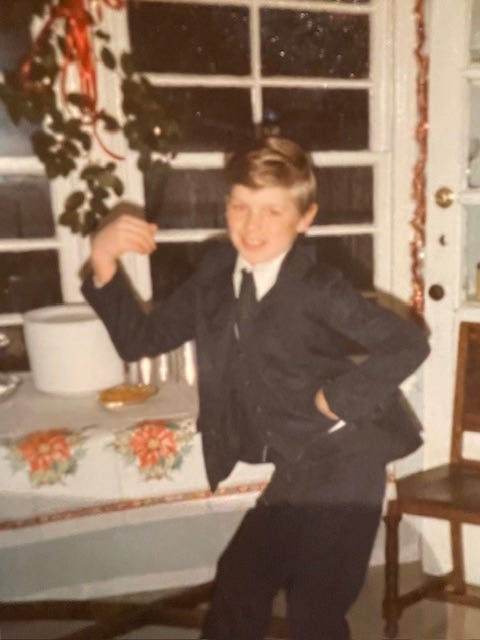
Even now, decades later, my mom and now Debi still throw their annual Christmas party. It’s smaller now, quieter. Every now and then, someone from those early years shows up. People like Susan and Jackie. And for a moment, when I hear about it, I’m taken right back into that warmth.
But beneath the music and movement, life was happening. And life, especially for the LGBTQ+ community in the 1980s, wasn’t always kind.
What I didn’t understand at the time, but have come to appreciate deeply, is what those nights meant. To me, they were fun. To them, they were sanctuary.
These weren’t just parties. They were places of safety and belonging for people who didn’t always have that out in the world. Teachers. Military members. Scientists. Artists. Some couldn’t be open about who they were in their workplaces or even with their families. But here, in our little house tucked in the woods, they could exhale. They could laugh loudly, love freely, dance wildly.
But sometimes the weight in the room would change. The lighter moments giving way to something more serious. I didn’t understand it then. Now I do.
Because between the laughter and the good times, there was life. There were the adult conversations that happen when people are carrying things, real things. Someone coming out to their family and the heartbreak when it went badly, or the joy when it went surprisingly well. Someone talking in hushed tones about a friend who left the bar and got jumped walking to their car, just for being gay. The fear that someone at work or a family member might find out the truth. I didn’t always understand the full weight of what was being said, but I could feel the seriousness in the room when the conversation shifted.
But it wasn’t all heavy. There was the normal stuff, too. Who was dating who, who broke up, and who maybe needed to break up. Gossip, laughter, teasing. The kind of things you’d hear in any close-knit circle.
And then, as I got a little older, a new word started showing up in those late-night conversations. AIDS. It was spoken softly, sometimes with fear, sometimes with confusion, always with gravity. I didn’t know what it meant at first, but I could sense its power and the way it unsettled even the most joyful rooms.
These nights were joy and protection all wrapped into one. As much as I remember the dancing and the laughter, I also remember someone crying in the kitchen and getting pulled into a hug. These people weren’t characters in a sitcom or a headline in a debate. They were brilliant, funny, complicated, loving humans fighting for space in a world that didn’t make it easy.
And for a while, that space was our home.
Up Next:
In the next chapter, I’ll share the story of Sue’s younger brother, Cousin Tommy. He brought joy, laughter, and style into my life. But he also brought the hard truths of what it meant to be visibly, unapologetically gay in the 1980s. Some lessons come with heartbreak. And sometimes, that heartbreak shows you just how much a person means to you.