

On the mat I found control. Off it, I lost my voice.
Even though Sue and my mom had split and it was now just my mom and me, things were good at home. We were settling into new routines in the townhouse, and life began to feel steady again.
But as I entered high school and moved deeper into my teenage years, I craved finding my own way in the world. I wanted to figure out who I was and where I belonged. I wanted to find my own path.
Discovering Wrestling
Growing up, I loved sports. I played baseball and soccer through grade school and middle school. I was never a star, but I was steady, better than average and certainly good enough to belong.
So when I tried out for the high school soccer team, I figured I’d slide right in.
Instead, I got cut. No excuses. The coach was right to cut me: I hadn’t earned it.
It stung. I didn’t want it badly enough, and I didn’t fit in with the other players. None of them were my friends, and I felt no connection with them. I was scared to fail when the pressure was real. I walked away embarrassed, a little lost, pretending it didn’t matter.
Then wrestling found me. Or maybe I found it. My mom had mentioned it once before, and in eighth grade gym class I’d gotten a taste of it. When winter sports sign-ups came around, I figured, why not?
In soccer, I could play the game of my life and still lose if the defense broke down. In baseball, I could get on base and still watch my team strike out.
But in wrestling, it was different. There was no one else to blame, no one else to carry me. Every win or loss was mine alone.
That accountability, terrifying at first, became exactly what I needed.
The first practices were brutal. Hot, sweaty, smelly, unforgiving. And yet, something about it grabbed me.
On the mat, everything else fell away. No chaos, no judgment. It was just me and my willpower.
I lost every match that first year, but I loved it. The scoreboard didn’t matter. What mattered was the fight and the strange peace I found in the middle of it.
The Grind and the Gift of Coaches
By sophomore year, something clicked. The moves made sense. My body caught up to the rhythm. And a big part of that change was the coaches.
They gave me structure I didn’t know I craved. They held me accountable, pushed me, and expected more than I thought I had.
I even loved practicing. The wall sprints, hallway runs, endless drilling, live goes. Everything became a competition: who could last, who could finish first, who wouldn’t puke.
It was misery, but it was my kind of misery. I thrived on it.
For all the individual focus, wrestling was also the first team where I felt like I belonged. We cut weight together, sat on long bus rides half-starved and half-asleep, and pushed each other through the hardest practices.
There was a strange pride in suffering side by side, in knowing everyone else was hurting too, but nobody quit.
Most of the time, you weren’t judged for who you were or where you came from; you were judged for your grit and toughness. And I had plenty of both.
For the first time, I wasn’t just a kid on the roster.
I was part of something.
Breakthrough and Setback
I started my sophomore year on JV behind an upperclassman named Mark.
The varsity coach told us there was no reason for a wrestle-off because Mark was so much better and more experienced.
I didn’t care. I just wanted to wrestle.
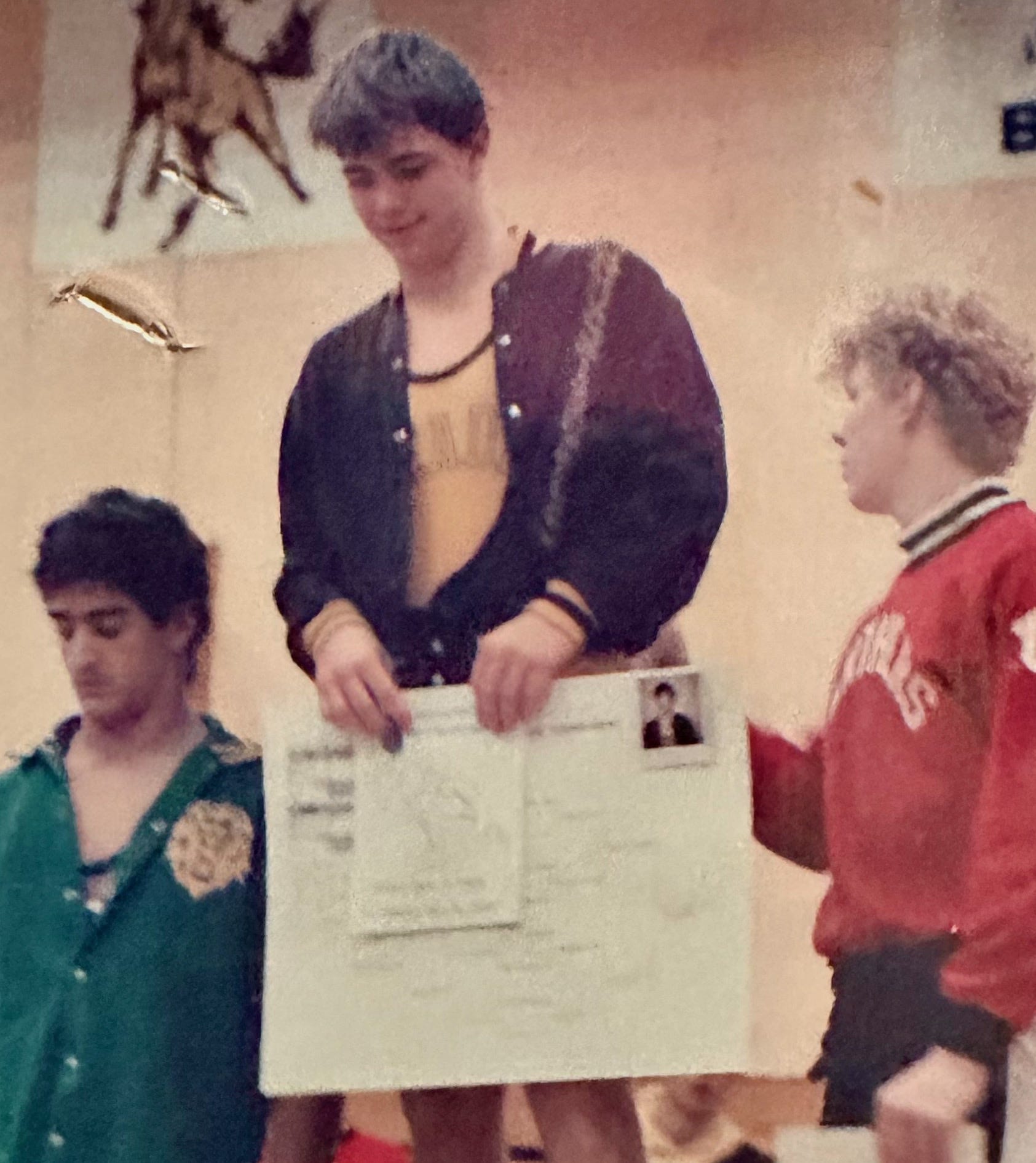
But after winning tournaments, staying undefeated, dominating a JV match against Northeast High, while watching Mark lose his varsity bout that same night, my coach pulled me aside:
“You’re wrestling off for varsity next week.”
After a grueling double-overtime match against Mark, I won. Suddenly, I was the 167-pound varsity wrestler at Meade High, facing some of the best in the state.
At my first tri-meet, I won my debut match, then lost my second to a kid who would finish second at states.
My coach told me he was proud, and that mattered more than the loss.
A week later at Arundel, I beat another future state placer in overtime.
Then came Glen Burnie.
Their 167-pounder would become the Maryland state champ that year. Our gym was packed.
I wrestled him scoreless through the first, even led 1–0 in the second. For a moment, I thought, I can do this.
Then his shoulder slammed into my knee. My leg buckled. I tried to fight, but after another shot, I injury-defaulted.
Weeks of PT followed. My coach taped my knee before every practice. I limped back for the postseason, seeded last.
First match? The same Glen Burnie senior.
I lost 4–1. He went on to win everything.
My high school season ended there.
Still, that spring I won the Maryland Junior Olympic state title for 9th and 10th graders and placed fifth at Mid-Atlantics.
Wrestling was becoming part of me.
Walking Away
Junior year, everything shifted.
I was wrapped up in the wrong crowd, making bad choices. My coach still believed in me, more than I believed in myself, but I couldn’t meet his expectations.
I started the season, but my heart wasn’t in it.
Midway through, I quit.
Dropped out of school, too.
Walking away meant leaving more than the sport.
My varsity coach had become the first positive adult, straight, male role model I’d ever had. With him, there was no judgment except one: If you give me your best effort, I don’t care about your faults.
That standard meant everything to me. He pushed me harder than anyone, and I gave him everything I had.
I can still see the disappointment in his eyes as we stood in the hallway outside his office at Meade High School, and he signed the paperwork.
That moment has haunted me for decades.
Wrestling With Silence
Wrestling gave me an outlet I desperately needed.
On the mat, I was free. No distractions. Just me and the truth of whether I had more fight than the other guy. Wrestling gave me structure when everything else felt unsteady.
But it also forced me to confront the fears that followed me everywhere.
The locker room was full of gay jokes and slurs. Words I’d already learned to tune out on the streets, in hallways, everywhere outside the safety of home.
And I knew exactly who those words were aimed at: my mom, Sue, Cousin Tommy, the friends who filled our dinners and Christmas parties with love and laughter.
My chosen family.
The people who had shown me more courage and resilience than anyone in those locker rooms could imagine.
And yet I stayed silent. I didn’t stand up for them.
That same year, we had one of the first female wrestlers in the state on our team. She showed up every day knowing she’d be judged, mocked, underestimated.
And she kept showing up anyway.
The worst part wasn’t her matches; it was the way some teammates treated her when coaches weren’t around. Hazing her, wrestling her with twice her size, pushing her around.
Every time she stepped onto that mat, I saw a reflection of the strength I’d grown up around.
My mom and Sue had shown me what resilience looked like, how to keep showing up in a world that didn’t always understand you.
She carried that same spirit, and I admired her for it, even as I stayed quiet.
In that wrestling room, instead of standing beside her, I froze.
She had the courage to step on the mat every day, knowing exactly what she was walking into.
I couldn’t even find the courage to say, enough.
Lessons From the Mat
Wrestling taught me more than how to score takedowns.
It taught me how far I could push my body when I wanted to give up.
It taught me how to stand back up after being thrown down, over and over.
And it taught me something harder: silence has a cost.
Winning on the mat didn’t erase the times I stayed quiet off it, and those moments carried a different kind of weight. That silence is one of my deepest regrets.
Even in my silence, I knew what courage looked like.
I had seen it every day at home.
I just hadn’t learned yet how to bring that courage into the world beyond our walls.
Wrestling became a mirror of my world. Love, discipline, belonging, and joy lived right beside fear, silence, and conflict.
I could win matches and prove myself, but I could not yet stand up. Not for her, not for myself, not against the ugliness in front of me.
And every time I stayed quiet, I felt the weight of letting down the people I loved most: my mom, Sue, Tommy, and the chosen family who had already taught me what real courage looked like.
And then I quit.
I quit wrestling, I quit school, I quit relationships, I quit jobs.
Quitting became my way of coping.
When something got uncomfortable or I didn’t like where it was headed, instead of standing up to it, I walked away from it.
At the time, it felt easier, even safer, to leave than to fight.
But each time I quit, I wasn’t just leaving the thing in front of me.
I was leaving pieces of myself behind.
Still, there was one outlet I didn’t quit: music.
It had been there all along, in my headphones, in the background, in the rhythms that gave me space to breathe.
Where wrestling demanded control, music offered escape.
Both carried me through those years, but as wrestling began to fade, music was waiting for me to lean on it more heavily.
Closing
Wrestling gave me a place where everything finally made sense.
On the mat, the noise quieted, and for a little while, I didn’t feel torn between two worlds. It was just me, my opponent, and the truth of that moment.
But as wrestling began to fade, I didn’t lose the lessons or stability I’d been given at home, they were still there, solid and waiting.
I just didn’t see how far I was starting to drift.
Without realizing it, I was slowly pulling away, trying to find my own place in the world.
Music was there to catch me, and at first, it felt like another safe place to land.
But in time, it would lead me down roads I wasn’t ready for, and into parts of myself I didn’t yet understand.
And that’s what we’ll talk about next, how music helped a confused young man find his voice, but also showed him a path he shouldn’t walk.