

Some people come into your life with a spark. Others show up with a fire. Cousin Tommy was a wildfire, and I adored him.
I don’t remember the first time I met Tommy. He was Sue’s younger brother, but to me, he’d always been part of the picture. Loud, loving, larger than life. In those early years, he still lived with their mom, but somehow he felt like a permanent fixture in our little world. Even after he moved into his own place, he never drifted far. He’d drop by just to say hi, sit for dinner, share a laugh. It never felt like a visit; it felt like home settling back into itself. Tommy had a way of filling a room with warmth, like sunlight through the window or the familiar sound of dogs barking at the screen door. He was part of the background and the center of things all at once.
Tommy was a big man. I’m sure he wasn’t as large as I remember, but in my memory, he towered over the world. Easily over six feet tall and well over 200 pounds, with a personality to match. Tommy didn’t whisper who he was, he lived it, loud and proud. He was gay, unapologetically. He never hid, never downplayed, never tried to “pass.” He was happiest when he was free to just be himself. And I loved him for that.
My mom and Sue used to joke that Tommy and I got along so well because we shared the same maturity level. But it was more than that. Tommy saw me. Really saw me. Not just as Sue’s partner’s kid, but as a young boy who needed a friend, someone safe, someone fun, someone who didn’t judge. And he decided to be that person for me.
Middle school was a confusing time. I didn’t know who I was, where I fit, or what “normal” even meant anymore. Like any kid, I struggled to find my place. But Tommy showed up and walked beside me during those years, never pushing, never correcting, just supporting me exactly as I was.
One of my favorite childhood memories is a day I spent with him in Washington, D.C. He picked me up early in the morning and we headed straight to Georgetown. We hit the thrift stores first, and I scored a tuxedo coat with tails that I absolutely loved. Then we went to the iconic Commander Salamander, a local punk store that defined cool in the 80s. I picked up my first pair of parachute pants, a mesh tank top, and a button with the store’s logo, that I still have to this day. We added some green and red hairspray and a few more “punker” essentials to the haul. Tommy was right there cheering me on, making me feel like I had found a superpower in those clothes.
On the way home, we stopped at a rib shack in the middle of the projects. It was the kind of place I never would’ve gone into on my own. It had bulletproof glass, a turnstile to pass the food through, and no frills. But Tommy walked in like he owned the place. He ordered a huge spread, and to this day, those were the best ribs I’ve ever eaten in my life.
Tommy made everything feel like an adventure. He declared Halloween the “National Gay Holiday” and celebrated it like it was sacred. He loved dressing up. He probably loved that Halloween gave him permission to be as flamboyant as he wanted to be without anyone batting an eye. Once, he showed up and asked if I wanted to go to the airport. The airport? I asked. “Yeah,” he said. “Let’s dress up, go to BWI, and people-watch.” So we did. John (Sue and Tommy’s actual nephew), Tommy, and me. We were dressed to the nines, wandering through the terminal like we belonged there. And as much as we were watching others, it was clear we were being watched too.
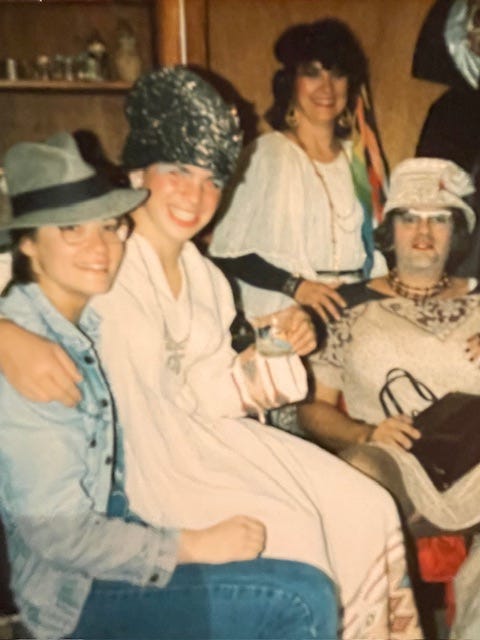
Drag shows? Don’t even get me started. If you think drag queens are dangerous or that a show will “turn” your kid gay, I’ve got news for you: I grew up front row, center. I laughed, I danced, I clapped through every number. And guess what? Still straight. Just more joyful for having been there. Tommy took me to more drag shows than I can count. And you know what I remember? Laughter. Singing. Joy. Community. Glitter. Happiness. What I did come away with wasn’t a changed identity, it was a deep love for self-expression and the courage to embrace joy out loud.
To me, Tommy was magic.
Looking back, it felt like nothing could dim his light. But magic can’t protect you from everything. What happened that one morning knocked the wind out of me.
I came into the living room and saw him covered in bruises, stitches, and bandages. He looked broken. Shaken. Not like himself. I asked what happened. My mom, always honest, didn’t sugarcoat it.
The night before, Tommy had left a gay bar in Baltimore and was walking to his car when a group of men pulled up in a truck. They jumped him. Beat him. Called him names like faggot, queer, homo. Told him he should die. They left him there, bloodied and battered, for no reason other than who he was.
I was in middle school by then. Old enough to start noticing the cracks in the world. I had already begun to hear the things boys at school said about gay people. Their cruelty, their mockery, their disgust. And when I asked if they knew any gay people, the answer was always the same: “No. And why would I want to?”
That was when it really hit me: Hate is taught. Ignorance is passed down like a family heirloom. And people like Tommy paid the price.
Seeing him hurt like that, physically and emotionally, changed me. I was confused. Angry. Scared. Because how could anyone look at someone like Cousin Tommy, someone so full of love and laughter and joy, and want to hurt him?
I still don’t have an answer for that.
Over the years, I’ve come to believe there are really only two kinds of people in this world: Those who hate, and those who know hate.
The people who hate? They’re often the most fearful, the most fragile, and the most misinformed among us. They mistake cruelty for conviction. They see difference and feel threatened. They wield ignorance like a weapon.
And then there are those who know hate. Not because they carry it, but because they’ve endured it. Survived it. Outlived it.
Cousin Tommy didn’t just know hate, he met it face to face.
And he chose to keep living out loud anyway. I can’t even imagine how much courage that must have taken.
That’s real strength.
That’s real courage.
And that’s the kind of legacy that lasts.
In the LGBTQ+ world, some said Tommy was lucky. He survived. But that survival came with scars. Ones I imagine went far deeper than the ones on his skin.
Eventually, like often happens in life, we drifted. I lost touch with Cousin Tommy over the years. But not a day goes by that I don’t carry him with me. His laughter. His support. His wild, beautiful spirit.
If I saw him again, I’d just wrap him in a hug and say, “Thank you.” For loving me. For seeing me. For being exactly who he was.
Up Next: Chapter 5 – Parking Lot Lessons
In the next chapter, I’ll share what I learned in the parking lots of the softball fields. Lessons about loyalty, love, and community, and the kinds of conversations that happened between innings, during doubleheaders, and long after the final out, under folding chairs and ballpark lights, when the stories mattered more than the score.
I love the reading!!!